
I still remember the day I lost $3,847 on my first Amazon product launch.
I thought I had found the perfect product. The margins looked great, the competition seemed low, and I was convinced this bamboo cutting board would be my ticket to e-commerce success. But I made one critical mistake: I never properly researched the keywords.
Three months later, my product sat buried on page 47 of Amazon search results. Nobody could find it because I was targeting keywords that nobody actually searched for. That painful lesson taught me something valuable: keyword research tools aren’t just nice-to-haves. They’re essential.
Over the past seven years, selling on Amazon and running multiple e-commerce stores, I’ve tested nearly every keyword research tool on the market. Some saved me thousands of dollars. Others weren’t worth the free trial period.
Today, I’m sharing the 10 best e-commerce keyword research tools that actually work in 2026. Whether you’re just starting out or doing six figures monthly, there’s a tool here that fits your needs and budget.
What Is E-commerce Keyword Research?
E-commerce keyword research is the Process of finding and analyzing the actual search terms people type into Amazon, Google, or other platforms when looking for products like yours.
Think of it this way: you might call your product a “bamboo cutting board,” but your customers might search for “wooden chopping block” or “eco-friendly kitchen board.” If you don’t know what they’re actually typing, they’ll never find your product.
The research process involves three steps. First, you discover potential keywords using specialized tools. Second, you analyze search volume, competition, and buyer intent. Third, you strategically place those keywords in your product listings, titles, and backend search terms.
Why E-commerce Keyword Research Matters

Here’s the truth: you can have the best product in the world, but if nobody can find it, you won’t make sales.
I learned this with my bamboo cutting board disaster. The product was excellent. The photos were professional. The price was competitive. But I was targeting “artisan bamboo cutting board” when most people searched for “large cutting board.” That one mistake cost me $3,847.
Proper keyword research does three critical things. First, it ensures your products show up in search results when customers are actively looking to buy. Second, it helps you understand what features customers actually care about. Third, it reveals market gaps where competition is low, but demand is real.
According to research, 70% of Amazon shoppers never look past the first page of search results. If your product isn’t ranking on page one for relevant keywords, you’re invisible to most buyers.
How Do I Test Keyword Research Tools?
Before we dive in, let me be transparent about my testing process.
I didn’t just sign up for free trials and write reviews based on screenshots. I used each tool for real product research over the course of 6 months. I tracked which tools gave me accurate data, which ones saved me time, and which ones actually helped me find profitable products.
Data accuracy mattered most. I compared keyword volumes against my actual Amazon PPC campaign data. Some tools were off by 300% or more.
Ease of use was critical. If a tool required a PhD to understand, it got marked down.
Value for money was immense. I looked at what you actually get for your investment.
Real-world results were the ultimate test. Did the tool help me find profitable keywords and products?
Which Keyword Research Tool is Best for E-commerce?
The honest answer? It depends on your situation.
If you’re brand new with a limited budget, start with Sonar (free) or Jungle Scout Basic ($29/month). If you’re doing $10,000+ monthly and serious about Growth, invest in Helium 10 Platinum ($79/month). If you’re managing multiple brands or doing $100,000+ in monthly revenue, you need DataHawk ($99-299/month) for advanced analytics.
But here’s what really matters: the best tool is the one you’ll actually use consistently.
Before I break down each tool in detail, here’s a quick comparison table:
Tool Name | Best For | Starting Price | My Rating |
Helium 10 | Serious Amazon sellers | $29/mo | ⭐⭐⭐⭐⭐ |
Jungle Scout | Beginners wanting accuracy | $29/mo | ⭐⭐⭐⭐⭐ |
MerchantWords | Deep keyword research | $30/mo | ⭐⭐⭐⭐ |
Sonar | Budget-conscious | Free | ⭐⭐⭐⭐ |
AMZ.One | Best value | $19.99/mo | ⭐⭐⭐⭐ |
Sellesta.com | AI optimization | $47/mo | ⭐⭐⭐⭐ |
DataHawk | Agencies | $99/mo | ⭐⭐⭐⭐ |
Exploding Topics | Trend hunters | $39/mo | ⭐⭐⭐⭐½ |
Backlinko | Content marketers | Varies | ⭐⭐⭐⭐ |
KeywordTool.io | Multi-platform | $69/mo | ⭐⭐⭐⭐ |
What Are the Best Keyword Research Tools for E-commerce?
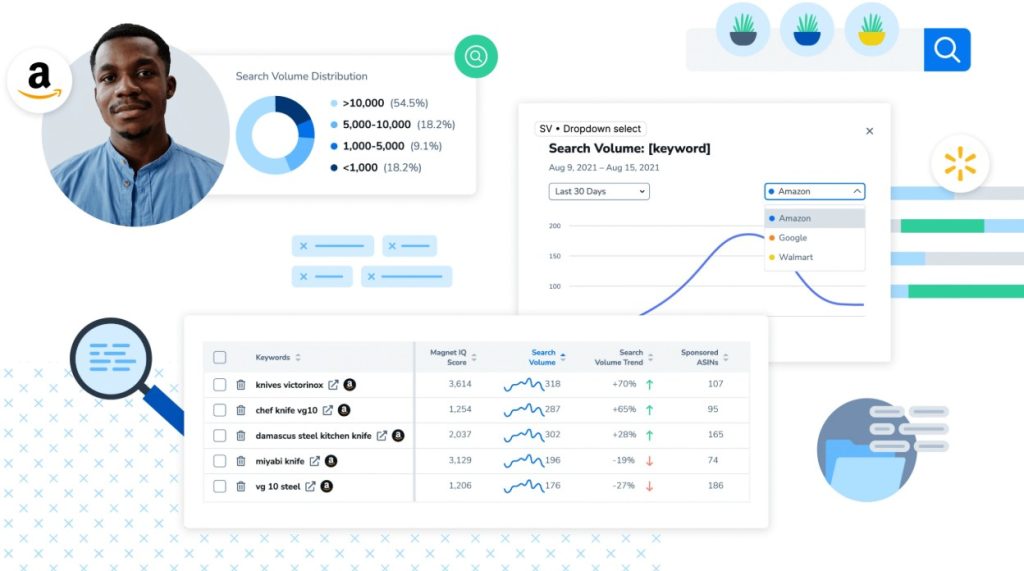
When I finally got serious about Amazon, Helium 10 changed everything for me.
The Cerebro tool alone is worth the subscription. You can enter any competitor’s ASIN and see all the keywords they’re ranking for. Last month, I analyzed my top three competitors in the pet supplies niche. Within 30 minutes, I discovered 47 keywords I completely missed. I added them to my listing, and my organic traffic jumped 34% in two weeks.
The Magnet tool generates thousands of keyword ideas from a single seed keyword. Type in “yoga mat” and get 2,000+ related keywords with search volumes and competition scores.
The reality: The learning curve is steep. I spent my first week watching YouTube tutorials. Pricing starts at $29 monthly, but most sellers need the $79 Platinum plan.
Key features:
- Cerebro for competitor keyword analysis
- Magnet for keyword generation
- Index Checker to verify Amazon indexed keywords
- Keyword Tracker for monitoring rankings
Pricing: Starter $29/month, Platinum $79/month, Diamond $229/month
Best for: Sellers doing $10,000+ monthly who need comprehensive tools.
Quick tip: Start with Cerebro and Magnet. Master those two first.
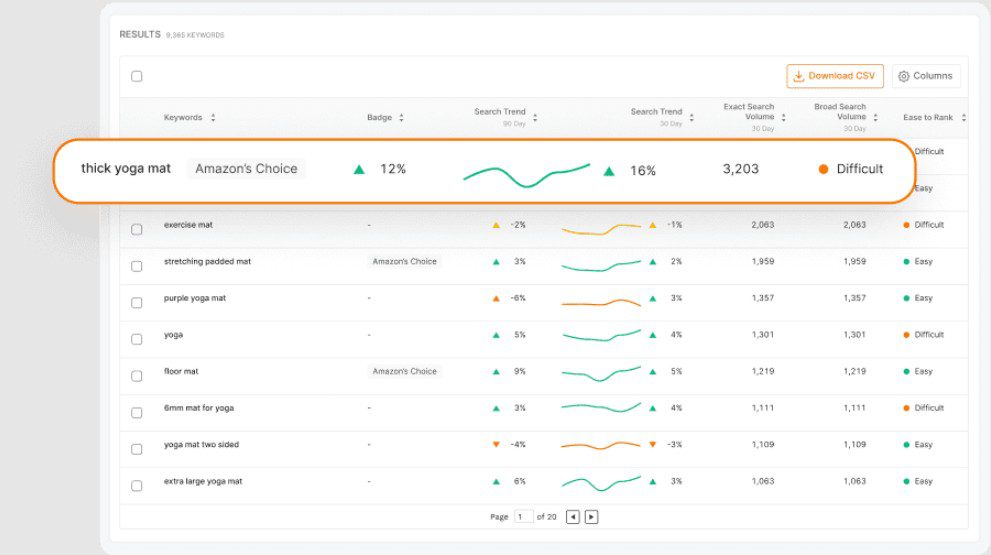
Here’s a secret: most keyword tools guess at search volumes. Jungle Scout has partnerships that provide more accurate data.
I once launched a product based on another tool showing 5,000 monthly searches. After disappointing sales, I checked Jungle Scout. The real number? 800 searches. That $4,200 mistake taught me to verify keywords with Jungle Scout.
The Accuracy Score gives you a 1-10 rating indicating the product’s success probability. Last quarter, I researched 12 products and only launched the three with scores above 7. All three became profitable within 60 days.
The downside: It doesn’t go as deep into keyword research as Helium 10. Better for product validation than generating 1,000 keyword variations.
Key features:
- Product Database with millions of products
- Opportunity Finder for profitable niches
- Keyword Scout for search volume data
- Supplier Database for manufacturers
Pricing: Basic $29/month, Suite $49/month, Professional $84/month
Best for: New sellers wanting to avoid costly first-product mistakes.
Quick tip: Use Opportunity Finder with filters: 300-500 monthly sales, competition below 40, price $15-$50.
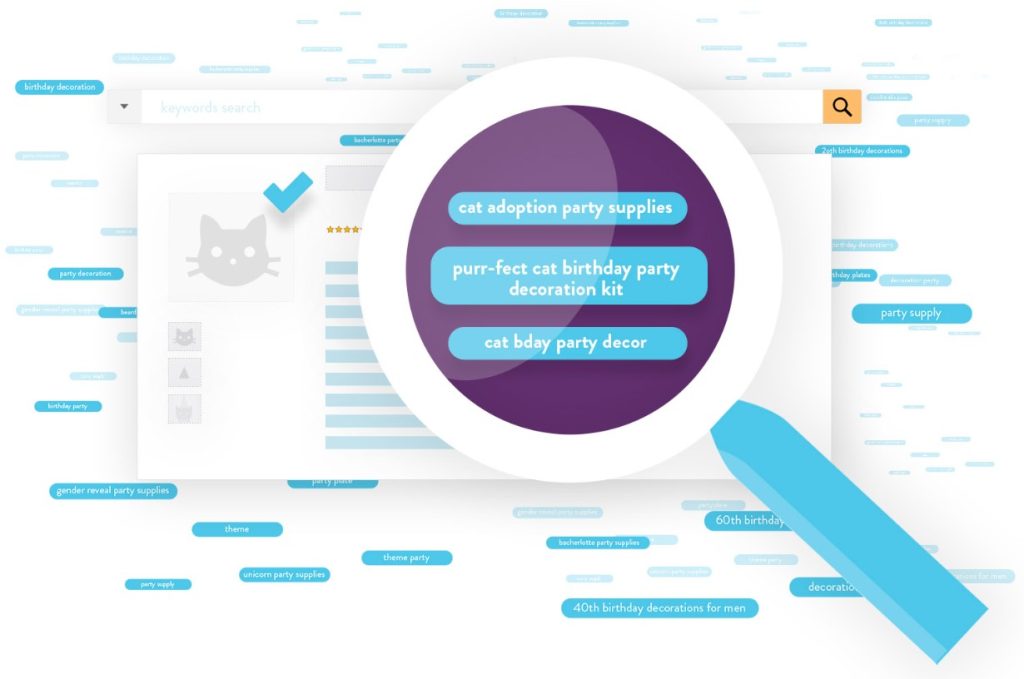
When I need deep keyword research, I turn to MerchantWords.
Historical trend data has changed how I plan launches. Last summer, considering a pool float product, MerchantWords showed “inflatable pool float” searches grew 340% between April and June, then dropped in September. That insight helped me time my launch perfectly.
The database includes over one billion Amazon search terms. When searching for long-tail keywords, MerchantWords finds obscure terms that other tools miss.
Key features:
- Billion+ keyword database
- 12 months of historical trend data
- Seasonal patterns analysis
- Multi-marketplace search
Pricing: $30/month or $264/year
Best for: Building content-rich listings or running sophisticated PPC campaigns.
Quick tip: Search your keyword, click “Related Keywords,” sort by volume, and look for year-over-year Growth.
Sonar is entirely free. Not a trial. Just free forever.
When my cousin wanted to start selling with only $500 for inventory, I recommended Sonar. She spent $0 on tools and used that money for product samples.
I still use Sonar with premium tools. Sometimes I need a quick keyword check.
The limitations: No rank tracking. No historical data. Basic keyword research only.
Key features:
- Unlimited free searches
- Amazon data from 9 countries
- Basic search volume estimates
- No registration required
Best for: New sellers, side hustlers, or validating ideas before investing in paid tools.
Quick tip: Export the top 50 suggestions. Type each into Amazon’s search bar. If it auto-completes, prioritize it.
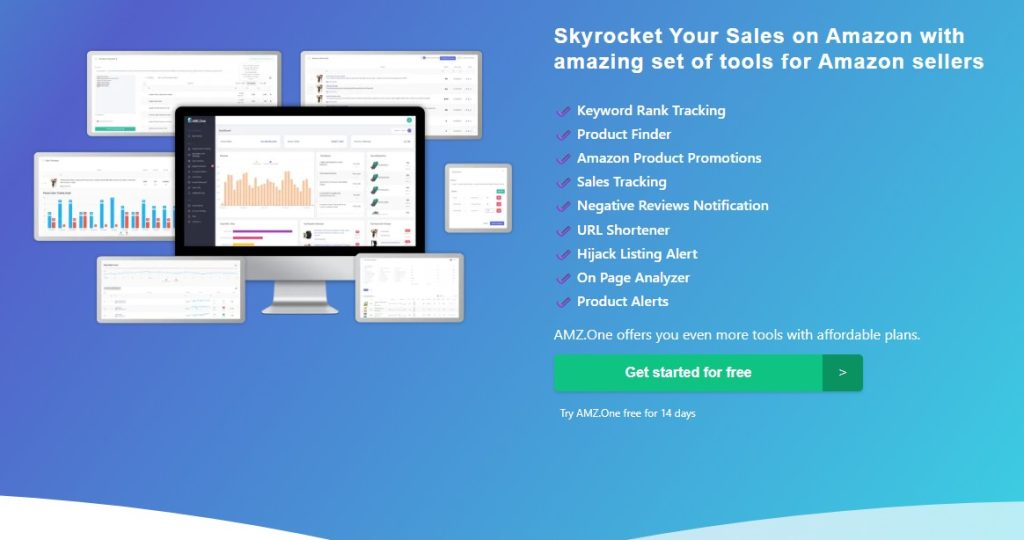
I discovered AMZ.One helping my friend start his business. He wanted premium features but couldn’t afford the $79+ monthly fee.
For $39.99 monthly, AMZ.One offers almost everything expensive tools provide: product research, keyword tools, reverse ASIN lookup, listing optimization, and rank tracking.
I tested it against Helium 10 for a week. Results were surprisingly similar. Helium 10 had more data points, but for basic research, AMZ.One held its own.
Key features:
- Product research database
- Keyword research and suggestions
- Reverse ASIN analysis
- AI-powered listing optimizer
- Keyword rank tracker
Pricing: Basic $19.99/month, Pro $39.99/month, Enterprise $79.99/month
Best for: Sellers doing $5,000- $20,000 in monthly revenue who want professional tools without premium pricing.
Quick tip: Use filters: price $20-$40, reviews under 300, rating above 4.0, sales 200-400 monthly.
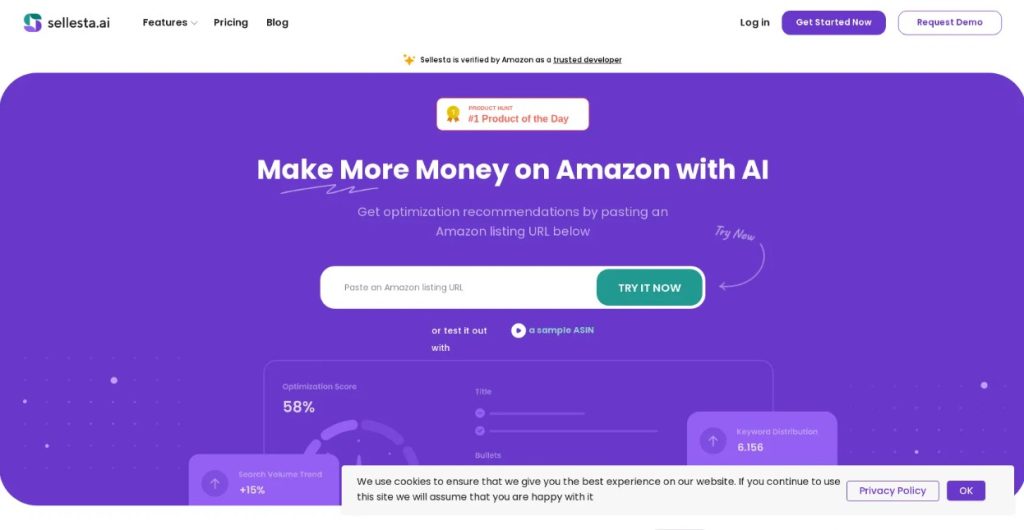
Most AI tools are marketing hype. Sellesta is different.
Instead of dumping keyword data, Sellesta analyzes your listings and tells you exactly what to fix. Last month, I ran my best seller through it. It gave me 12 recommendations, including three keywords that were missing. I implemented them over a weekend.
Result? My conversion rate went from 11% to 14.5%. That’s an extra $1,800 monthly from a product I thought was optimized.
Key features:
- AI-powered optimization suggestions
- Smart keyword recommendations
- Competitor tracking and alerts
- PPC keyword suggestions
- Performance scoring
Pricing: Starter $47/month, Growth $97/month, Professional $197/month
Best for: Sellers with 5-20 existing products needing optimization rather than new launches.
Quick tip: Connect your best-selling ASIN first. Focus on “Quick Wins.” See improvements within two weeks.
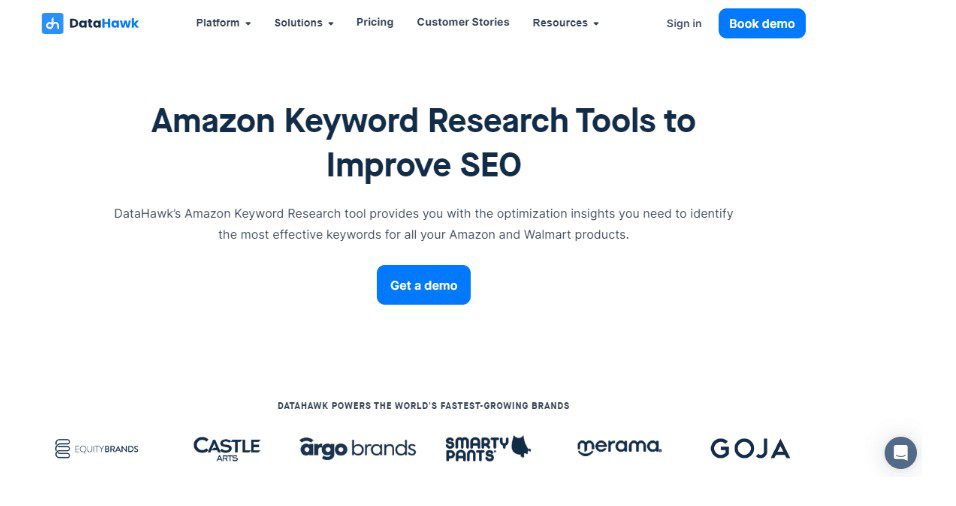
When I started managing three Amazon brands, I needed something more powerful. DataHawk filled that gap.
The custom dashboards save me hours weekly. I built different views for each brand. My investors love the professional reports I generate in minutes.
The market share tracking shows exactly how my products perform against competitors in real-time.
Key features:
- Advanced keyword analytics
- Market share monitoring
- Competitor benchmarking dashboards
- API access for integrations
- Multi-marketplace intelligence
Pricing: Professional $99/month, Business $299/month, Enterprise custom
Best for: Agencies managing multiple clients or brands with 50+ ASINs doing $100,000+ monthly.
Quick tip: Start with the Market Share module. Track your top category and five main competitors.
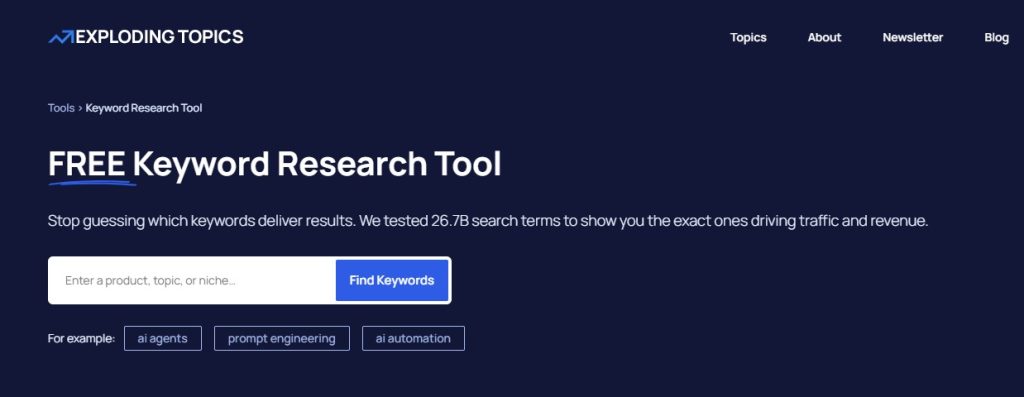
Exploding Topics helped me discover three winning products before they became saturated.
In early 2025, it showed “massage gun” searches growing 200% yearly, but the trend was still early. I launched a product and had six months of low competition. By the time 50 sellers jumped in, I had 200+ reviews and top rankings locked in.
Key features:
- Trend discovery algorithm
- Month-over-month growth metrics
- Category filtering
- Historical validation
- Email alerts
Pricing: Free (limited), Entrepreneur $39/month, Investor $99/month
Best for: Sellers taking calculated risks on emerging categories rather than established niches.
Quick tip: Filter by “Consumer Products,” set Growth to “Exploding.” If products have fewer than 100 reviews, you’ve found an early opportunity.
Backlinko isn’t a traditional keyword tool. It’s something different and sometimes more valuable.
The educational resources taught me to think strategically about keywords. When I started building content for my Shopify store, Backlinko’s Skyscraper Technique helped me outrank competitors with 10 times more authority.
While Backlinko teaches strategy, you’ll still need actual keyword research tools for data. If you’re building SEO-focused content or websites, pair Backlinko’s methods with dedicated keyword tools. Our guide on the best keyword research tools for SEO covers tools like Ahrefs, SEMrush, and Moz that provide the search volume data and competitor insights Backlinko’s strategies require.
What you get:
- Free comprehensive blog content
- YouTube strategy tutorials
- Skyscraper Technique
- Competitor analysis frameworks
- Case studies with real results
Pricing: Free blog/YouTube, paid courses $497-$997
Best for: Building authentic brands beyond Amazon, with Shopify stores or blogs.
Quick tip: Start with the free Skyscraper Technique guide. Find the top 10 articles in your niche, and create better content.
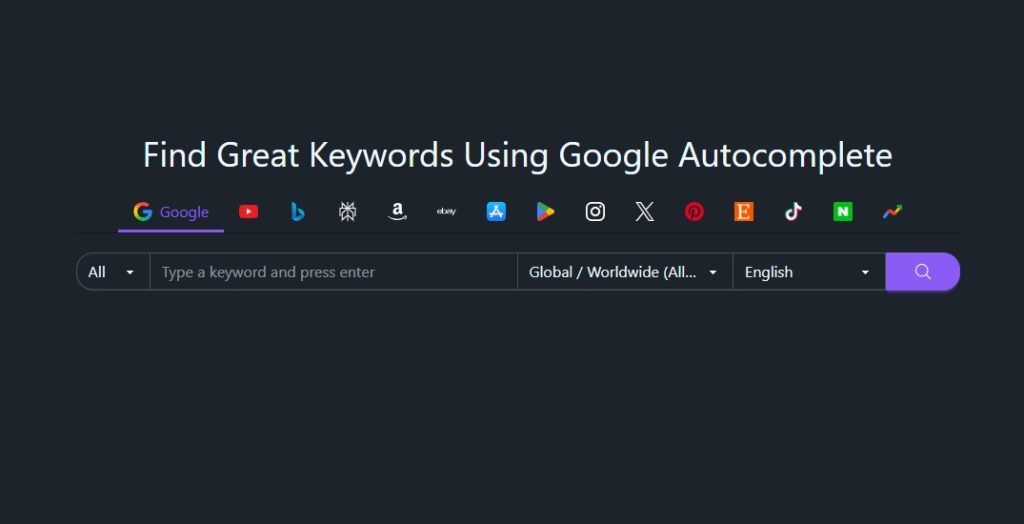
When I expanded beyond Amazon to eBay, Shopify, and YouTube, I needed a tool that worked across all platforms.
One tool searches Amazon, Google, YouTube, eBay, Instagram, and more. The autocomplete feature scrapes real search suggestions, showing precisely what users type.
When I launched my YouTube channel, KeywordTool.io helped me find video keywords that got views. I went from 50 views per video to 2,000+.
Key features:
- Multi-platform search (10+ platforms)
- Autocomplete scraping
- Long-tail keyword generation
- Search volume data (Pro version)
- Question-based keyword discovery
Pricing: Free (limited), Pro Basic $69/month, Pro Plus $79/month, Pro Business $159/month
Best for: Multi-platform sellers creating YouTube or blog content, running multi-channel PPC.
Quick tip: Use the Amazon setting, filter by “Questions,” and find “how to” keywords. Create A+ Content answering these.
Helium 10 vs Jungle Scout: Which Tool Should You Choose for Amazon Keyword Research?

This is the question I get asked most. Both are excellent but serve different purposes.
Choose Helium 10 if:
- Managing 10+ products actively
- Need deep keyword research with thousands of variations
- Want comprehensive tools beyond product research
- Doing $20,000+ monthly
Choose Jungle Scout if:
- Launching your first 1-5 products
- Want the most accurate sales and search data
- Prefer ease of use over feature depth
- Just starting or doing under $30,000 monthly
Honestly, I use both. Jungle Scout for validation, then Helium 10 for deep research. But if I could only pick one, it would be Helium 10 for long-term versatility.
How Do I Choose the Right E-commerce Keyword Research Tool for My Business?

Let me help you match your situation with the right tool.
Just starting out ($0-$5,000 monthly): Start with Sonar for free validation. When ready to launch, invest in Jungle Scout Basic at $29 monthly. This combo provides everything you need.
Growing your business ($5,000-$30,000 monthly): Upgrade to Jungle Scout Suite ($49) or AMZ.One Pro ($39.99). Both give comprehensive features without breaking the bank.
Scaling operations ($30,000-$100,000 monthly): Move to Helium 10 Platinum ($79) or add Sellesta ($97) for optimization. Consider adding MerchantWords ($30) for seasonal planning.
Established or Enterprise ($100,000+ monthly): Invest in Helium 10 Diamond ($229) plus DataHawk ($299+). Add Sellesta to optimize your catalog.
Frequently Asked Questions
Where exactly will my press release appear?
Your press release is published exclusively on The Tool Marketer (thetoolmarketer.com). We are an online press release publishing platform—not a traditional wire distribution service.
How long does publishing take?
You can absolutely start with free tools. My cousin launched her first profitable product using only Sonar and Amazon’s autocomplete. She made $8,000 in her first three months with zero tool costs.
But paid tools save time and reduce risk. If a $50 monthly tool prevents one $3,000 failed product launch, it pays for itself for three years.
Is the backlink dofollow or nofollow?
Sonar wins easily. It’s permanently free with no catches, no credit card required, and unlimited searches
Will journalists see my press release?
Most Amazon-specific tools like Helium 10, Jungle Scout, and AMZ.One only works for Amazon. For multi-platform keyword research, use KeywordTool.io. It covers Amazon, eBay, Google, YouTube, and more.
How is this different from traditional PR distribution services?
I target 200-300 total keywords per listing:
- 5-10 primary keywords (high volume, directly describe product)
- 30-50 secondary keywords (medium volume, buyer-intent terms)
- 150-200 long-tail keywords (lower volume, specific use cases)
Use primary keywords in the title, bullets, and description. Put secondary keywords in bullets and backend search terms.
Do you guarantee media pickup or press coverage?
Start with monthly subscriptions for your first 90 days. This lets you test whether the tool fits your workflow. After three months, if you’re using it regularly, switch to annual billing. Most tools offer 20-30% discounts for annual commitments.
What makes your PR distribution website different?
No tool guarantees success. These tools provide data and insights. You still need to interpret that data and execute well.
That said, quality tools dramatically increase your odds. Before I used proper research tools, about 1 in 10 of my product ideas succeeded. Now, with systematic research, about 5 in 10 products I launch become profitable.