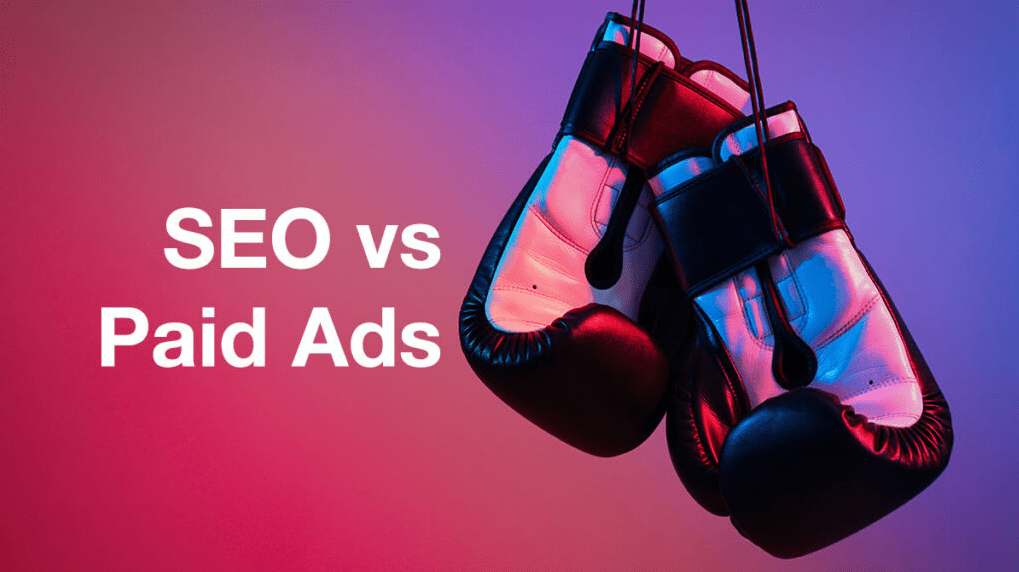
Are you a business owner or marketer looking for the best way to drive traffic to your website? You’ve likely heard of both SEO and Paid Ads, and you may be wondering which one is the better investment.
This is a crucial question. Both SEO (Search Engine Optimization) and Paid Ads are powerful marketing strategies, but they operate on fundamentally different principles. Understanding these differences—cost, time, and sustainability—is the key to building a winning long-term strategy for your business.
To truly grasp the difference between SEO vs Paid Ads, let’s use a highly memorable analogy:
SEO is like Weight Lifting. It takes consistent, hard work to build strength, but the results are long-lasting.
Paid Advertising is like an Energy Shot. It gives you an immediate, powerful boost, but you have to keep paying for it, and the results vanish the moment you stop.
Let’s break down this SEO vs Paid Ads comparison to help you find the right balance for your business.
SEO: The Long-Term Growth Strategy (Weight Lifting Approach)
When you start a weight-lifting routine, you don’t get a six-pack overnight. It takes weeks of dedicated work to build up strength and see results. The same is true when comparing SEO vs Paid Ads—SEO is a process of earning traffic, not buying it.
As you consistently put in the effort, Google begins to recognize your website as a trustworthy and authoritative source in your industry. This is a gradual process of building your site’s “strength.”
Key Characteristics of SEO (The “Workout Plan”):
Time to Results: Be patient. Expect SEO efforts to take between 3 and 6 months to start showing significant results. This is because Google needs time to crawl, index, and understand your website and its value.
Sustainability: When you stop working out, you don’t lose all your strength immediately; it declines over time. The same applies to organic traffic. A well-optimized page can continue to drive traffic for months or even years after the initial work is complete.
Investment: You’re not paying for each click. Your costs are an investment in a valuable, long-term asset. This includes the time and effort of your team or agency to execute a comprehensive strategy.
Your Comprehensive SEO “Workout Plan” Includes:
Onsite Tactics:
- Improving website speed and Core Web Vitals
- Fixing broken links and technical errors
- Optimizing content with target keywords in titles, headings, and image alt tags
- Enhancing user experience (UX) and mobile responsiveness
- Creating high-quality, valuable content that answers user intent
Offsite Tactics:
- Building your site’s authority off-page
- Exhaustively optimizing your Google Business Profile
- Receiving and responding to customer reviews
- Earning high-quality backlinks from reputable sources like trade associations, press releases, and industry partnerships
- Building brand mentions and citations across the web
Bottom Line: SEO is traffic that you EARN, and in the SEO vs Paid Ads debate, it provides compounding returns over time.
Paid Advertising: The Immediate Traffic Solution
Paid advertising, specifically Google Ads, gives you instant traffic. You set up a campaign, provide your payment information, and within minutes, your ad is live, and people are clicking on it. But you are paying for every single one of those clicks.
This is a powerful and essential tool for generating immediate leads and sales, but it comes with a significant catch in the SEO vs Paid Ads comparison.
Key Characteristics of Paid Ads (The “Instant Boost”):
Time to Results: Immediate results. Traffic can start flowing to your website as soon as your campaign is approved and turned on.
Sustainability: When you stop paying for the ads, your traffic instantly crashes to zero. There is no lingering effect—a critical factor in the SEO vs Paid Ads decision.
Investment: The costs can add up fast. You pay per click, and prices vary dramatically by industry. For example:
- Plumbers: “plumber near me” can cost $15-$50 per click
- Injury Lawyers: “personal injury lawyer near me” can cost $60-$300 per click
- Moving Companies: “moving company near me” can cost $12-$20 per click
- E-commerce: Product-related keywords can range from $0.50-$5 per click
- SaaS: B2B software keywords can cost $20-$100+ per click
Because you are paying for every visitor, you must ensure your website is built to convert. That expensive click is worthless if the visitor lands on a confusing page with no clear call to action.
Bottom Line: Paid advertising is traffic that you RENT, not own.
SEO vs Paid Ads: The Ideal Marketing Strategy is a Balanced Approach
The worst position for a business is total dependence on paid advertising. In this scenario, you’re always paying for all your leads and have no organic safety net. If ad costs rise, a competitor outbids you, or your budget gets cut, your lead flow can vanish overnight.
The most innovative approach in the SEO vs Paid Ads debate is to use both strategies in a balanced, synergistic way.
Think of it as a Three-Phase Roadmap:
Phase 1 (The Launch): Start with Paid Ads
- Use paid advertising to get immediate leads and cash flow, especially if you’re a new business or launching a new product.
- Test which keywords and messaging work best before committing to a long-term SEO strategy
- Gather data on conversion rates and customer acquisition costs.
- Typical duration: 1-3 months
Phase 2 (The Investment): Build Your SEO Foundation
- Reinvest a portion of the revenue you generate from paid ads into building your organic foundation
- Hire an SEO professional or start putting in consistent work on content creation and backlink building
- Continue running paid ads, but begin creating high-quality, optimized content
- Implement technical SEO improvements and build domain authority
- Typical duration: 3-12 months
Phase 3 (The Optimization): Achieve Balance
- As your SEO efforts begin to mature and your organic traffic grows, gradually reduce your ad spend dependency
- Use paid advertising strategically to fill gaps in your lead flow or target specific, high-value campaigns
- Monitor the performance of both channels and adjust budgets based on ROI
- Ongoing optimization and maintenance
The Golden Ratio
Your ultimate goal should be achieving a balanced mix—ideally a 60/40 to 50/50 split between organic and paid traffic. This provides:
- Stability: Organic traffic offers a foundation that doesn’t disappear if budgets are cut
- Flexibility: Paid ads can be scaled up or down based on business needs
- Risk Mitigation: You’re not entirely dependent on either channel
- Competitive Advantage: Dominating both organic and paid results increases brand visibility and trust
SEO vs Paid Ads: Complete Comparison Table
AspectSEO (Weight Lifting)Paid Ads (Energy Shot)
Cost Upfront/ongoing labor cost; clicks are “free” once ranked Immediate cost-per-click; ongoing expense
Time to Results 3-6+ months Minutes to hours
Sustainability Results are long-lasting and decline gradually. Traffic stops immediately when you stop paying.
Control: Less direct control; influenced by algorithm updates. High control over targeting, ad copy, and budget.
Trust Factor Perceived as more trustworthy by users (organic results) Labeled as “Sponsored” or “Ad.”
Traffic Type: Earned Traffic (owned asset), Rented Traffic (temporary access)
Click-Through Rate Higher CTR for top organic positions (28-45%) Lower CTR for ads (2-5% average)
Scalability: Difficult to scale quickly; requires consistent effort. Highly scalable with increased budget.
Best For Long-term growth, brand building, and sustainable traffic. Immediate results, testing, seasonal campaigns
ROI Timeline: Increasing returns over time (compound effect). Immediate but flat returns; stops when the budget ends.
When to Choose SEO Over Paid Ads
You should prioritize SEO in the SEO vs Paid Ads decision when:
- You have a limited advertising budget, but you can invest time and effort
- You’re building a long-term brand with evergreen content
- Your industry has extremely high cost-per-click rates
- You want to establish authority and trust in your niche
- You can wait 3-6 months for results to materialize
- You’re in a competitive space where paid ads are saturated
Real-World SEO Success Example:
A local plumbing company invested $2,000/month in SEO for 8 months. After initial investment:
- Organic traffic increased from 200 to 2,500 monthly visitors
- Generated 150+ qualified leads per month from organic search
- Reduced reliance on paid ads from 100% to 30%
- Total marketing cost decreased by 60% while lead volume tripled
When to Choose Paid Ads Over SEO
You should prioritize Paid Ads in the SEO vs Paid Ads debate when:
- You need immediate traffic and leads (new product launch, seasonal offer)
- You’re testing a new market or product before committing to SEO
- You have a budget available and need fast results
- Your business model has a high customer lifetime value that justifies high CPCs
- You’re running time-sensitive promotions or events
- You want precise targeting (location, demographics, interests, behavior)
Real-World Paid Ads Success Example:
An e-commerce store selling fitness equipment launched a Black Friday campaign:
- Spent $5,000 on Google Ads over 10 days
- Generated $32,000 in revenue
- 540% ROAS (Return on Ad Spend)
- Captured immediate market share during peak season
The Hidden Costs: What Most Businesses Miss in SEO vs Paid Ads
Hidden Costs of SEO:
- Content creation time and expertise
- Technical SEO implementation (developer costs)
- Link building, outreach, and relationship management
- SEO tools and software subscriptions ($100-$500/month)
- Ongoing algorithm update adaptations
- Opportunity cost of delayed results
Hidden Costs of Paid Ads:
- Landing page optimization and A/B testing
- Ad creative design and copywriting
- Campaign management time (or agency fees, 10-20% of ad spend)
- Wasted spend on the learning curve and testing
- Rising CPCs as competition increases
- Platform fees and minimum spends
Pro Tip: When calculating the actual cost of SEO vs Paid Ads, factor in all hidden expenses to get an accurate ROI comparison.
2026 Trends Impacting SEO vs Paid Ads Decisions
SEO Trends:
- AI-Generated Content: Google’s helpful content updates favor genuine expertise over mass-produced AI content
- E-E-A-T Signals: Experience, Expertise, Authoritativeness, and Trust are more critical than ever
- Generative Engine Optimization (GEO): Optimizing for AI answer engines like ChatGPT and Perplexity
- Core Web Vitals: User experience metrics directly impact rankings
- Voice Search Optimization: Conversational queries require different optimization approaches
Paid Ads Trends:
- AI-Powered Bidding: Machine learning optimizes bids in real-time for better ROI
- First-Party Data: Cookie deprecation forces reliance on owned customer data
- Video and Visual Ads: Short-form video ads dominate on YouTube and Display networks
- Automation: Performance Max campaigns reduce manual management needs
- Privacy-First Targeting: Less granular targeting requires better creative and offers
Common Mistakes in the SEO vs Paid Ads Battle
SEO Mistakes to Avoid:
- Expecting immediate results – SEO takes time; don’t abandon it after 2 months
- Keyword stuffing – Focus on natural, valuable content, not keyword density
- Ignoring technical SEO – Speed, mobile-friendliness, and site structure matter
- Building low-quality backlinks – Toxic links can harm rankings permanently
- Neglecting content updates – Refresh old content to maintain rankings
Paid Ads Mistakes to Avoid:
- Poor landing page experience – Sending clicks to slow, confusing pages wastes money
- No conversion tracking – You can’t optimize what you don’t measure
- Ignoring negative keywords – Filter out irrelevant searches to reduce wasted spend
- Set-it-and-forget-it mentality – Ads require constant monitoring and optimization
- Bidding on brand terms only – Capture new audiences beyond those already searching for you
Making Your SEO vs Paid Ads Decision: Action Steps
Here’s precisely how to implement a balanced strategy:
Step 1: Audit Your Current Situation
- Analyze your current traffic sources (organic vs. paid vs. referral vs. direct)
- Calculate customer acquisition cost (CAC) for each channel
- Assess your content quality and technical SEO health
- Review competitor strategies in both organic and paid results
Step 2: Set Clear Goals and Timeline
- Define specific, measurable objectives (traffic, leads, revenue)
- Establish realistic timelines (immediate needs vs. long-term growth)
- Allocate budget based on goals (60/40, 70/30, or 50/50 split)
Step 3: Implement Quick Wins
- SEO Quick Wins: Fix technical errors, optimize existing high-traffic pages, claim and optimize Google Business Profile
- Paid Ads Quick Wins: Launch brand campaigns, retargeting campaigns, and test high-intent keywords
Step 4: Build Your Long-Term Foundation
- Create comprehensive content targeting your core keywords
- Build quality backlinks through outreach, PR, and partnerships
- Refine paid campaigns based on performance data
- Test new ad formats and targeting options
Step 5: Monitor, Measure, and Optimize
- Track key metrics weekly: organic rankings, ad CTR, conversion rates, ROI
- Adjust budget allocation based on performance
- Scale what works, cut what doesn’t
- Continuously test new approaches in both channels
Conclusion: SEO vs Paid Ads – You Need Both
Don’t fall into the trap of choosing one over the other in the SEO vs Paid Ads debate. The most successful businesses are those that understand the strengths of both and use them to build a powerful, sustainable marketing machine.
FAQs: SEO vs Paid Ads
Q: Is SEO better than Paid Ads for small businesses?
A: For most small businesses, SEO offers better long-term ROI than Paid Ads alone. While SEO takes 3-6 months to show results, it builds sustainable traffic that doesn’t disappear when you stop paying. However, the best approach in the SEO vs Paid Ads decision is using paid ads initially for immediate cash flow while simultaneously building your SEO foundation for long-term growth.
Q: How much should I budget for SEO vs Paid Ads?
A: Budget allocation in the SEO vs Paid Ads debate depends on your business stage. New businesses should allocate 60-70% to paid ads for immediate results, then shift to 50/50 as organic traffic grows. Established companies can allocate 60% to SEO and 40% to paid ads. Most small businesses need at least $1,500-3,000/month for effective SEO and $1,000-5,000/month for paid ads, depending on industry competition.
Q: Can I do SEO and Paid Ads at the same time?
A: Yes, and you absolutely should! Running SEO and Paid Ads simultaneously is the most innovative approach in the SEO vs Paid Ads strategy. Paid ads provide immediate traffic and revenue while your SEO efforts build long-term organic visibility. The two channels complement each other—paid ads data informs SEO keyword strategy, while a strong organic presence improves Quality Score in paid campaigns.
Q: How long does SEO take compared to Paid Ads?
A: In the SEO vs Paid Ads timeline comparison, paid ads deliver results in hours to days, while SEO typically takes 3-6 months to show significant results. However, SEO results are cumulative and long-lasting—a well-optimized page can drive traffic for years. Paid ads stop delivering the moment you stop paying. Think of SEO as building an asset, while paid ads are renting traffic.
Q: Which has better ROI: SEO or Paid Ads?
A: Long-term, SEO typically delivers higher ROI than Paid Ads because traffic is “free” once you rank. However, ROI depends on your timeline and business model. In the SEO vs Paid Ads ROI comparison, paid ads often show positive ROI within weeks, while SEO requires 6-12 months to break even, but then provides compounding returns. The best ROI comes from using both strategically, based on your business needs and timeline.